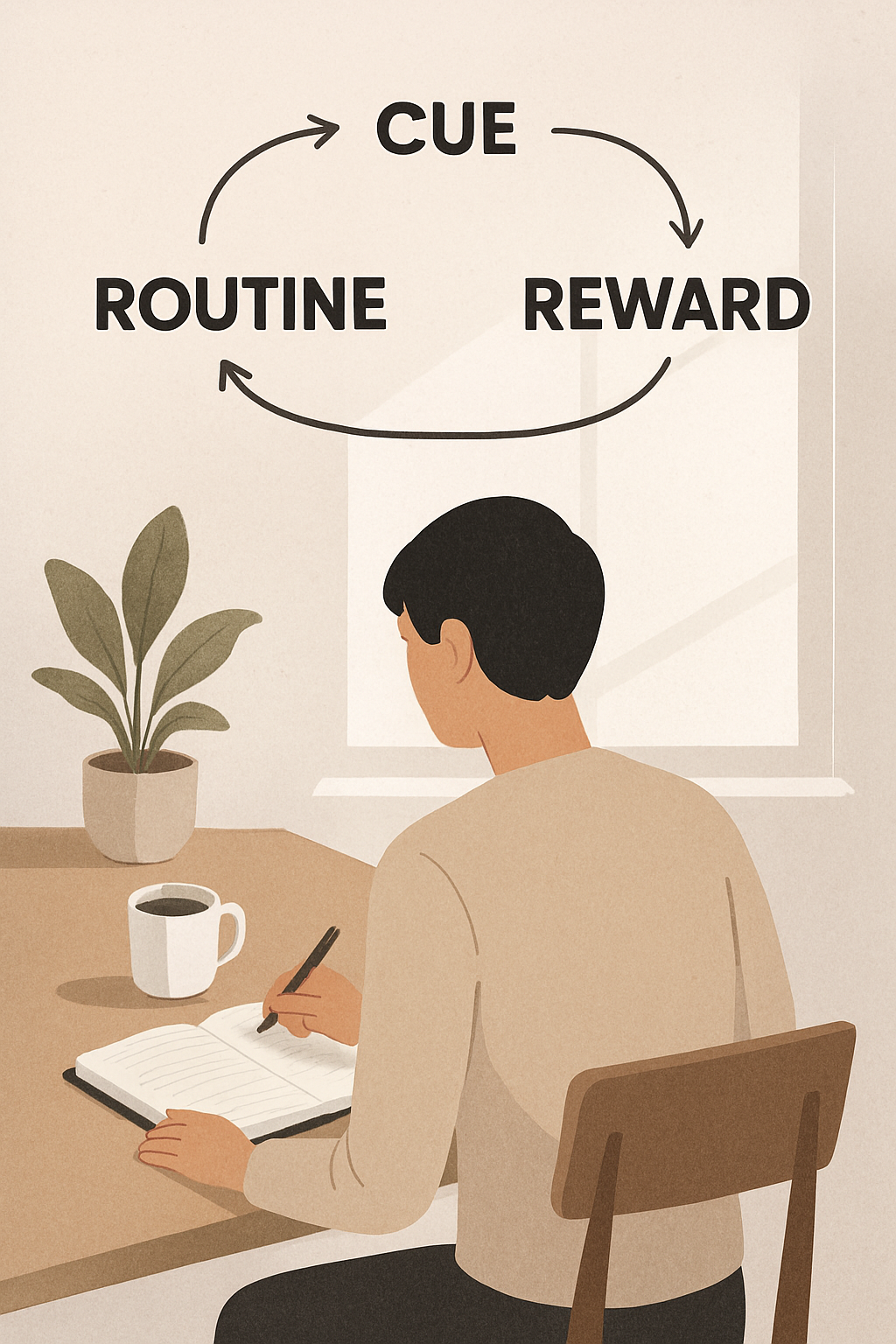
Habits are often misunderstood as a matter of discipline or motivation. In reality, most daily behaviors operate through a simple but powerful structure known as the habit loop — a process that explains why some routines stick effortlessly while others fail repeatedly.
Understanding how the habit loop works allows routines to be built in a way that feels natural, sustainable, and aligned with real life rather than forced through willpower alone..
This article breaks down the habit loop and shows how small cues can shape lasting routines over time.
What Is the Habit Loop and How Does It Work?
The habit loop explains how cues, routines, and rewards interact to create automatic behaviors over time.
The habit loop is a behavioral framework describing how habits form and repeat. It consists of three interconnected elements:
- Cue – a trigger that initiates the behavior
- Routine – the behavior itself
- Reward – the outcome that reinforces repetition
When this loop is repeated consistently, behaviors gradually become automatic.
Importantly, habits are not created by intensity, but by repetition within a stable context.
Why Cues Matter More Than Motivation
Motivation fluctuates daily. Energy levels, stress, sleep, and external demands constantly influence how motivated a person feels.
Cues, however, operate independently of motivation. They are environmental or situational signals that prompt action automatically.
Common examples of cues include:
- A specific time of day
- A physical object (notebook, phone, water bottle)
- A location or transition (starting work, finishing a meal)
When cues are consistent, behaviors require less conscious effort to begin.
Habit Formation Is an Environmental Process
Behavior is strongly shaped by context. Small environmental cues often influence actions more than conscious intention.
For example:
- A visible notebook encourages writing
- A prepared workspace reduces friction
- Consistent timing reinforces repetition
Rather than forcing discipline, effective routines reduce resistance. Designing an environment that supports behavior increases consistency without constant effort.
This perspective aligns closely with how daily habits influence long-term well-being, where small actions compound over time to support mental and physical balance.
👉 Learn more in:
Daily Habits That Support Long-Term Well-Being
The Role of the Routine
The routine is the action performed after the cue appears. Habits fail most often when routines are designed too aggressively.
Effective routines share common traits:
- They are easy to repeat
- They fit into existing daily structure
- They respect physical and mental energy limits
Starting below maximum capacity increases the likelihood that routines survive busy or low-energy days.
Rewards Reinforce Consistency
Rewards close the habit loop. They provide feedback to the brain that a behavior is worth repeating.
Rewards do not need to be dramatic. Often, they are subtle:
- A sense of completion
- Reduced stress
- Mental clarity
- Satisfaction from consistency
When rewards are immediate and predictable, habits strengthen faster.
Over time, the routine itself can become intrinsically rewarding.
Why Most Habit Systems Fail
When the habit loop is ignored, even well-designed routines tend to break down under real-life conditions.
Many habit systems break down because they ignore how the habit loop functions in real environments.
Common mistakes include:
- Relying on motivation alone
- Ignoring environmental cues
- Designing rigid routines
- Treating missed days as failure
Sustainable habits allow for flexibility and recovery rather than perfection.
This principle is explored in more depth here:
👉 Why Most Habits Fail — And How to Build Routines That Actually Stick
How Habits Support Focus and Mental Clarity
When habits become automatic, they reduce decision fatigue. Fewer daily decisions preserve mental energy for focus, creativity, and problem-solving.
This is especially relevant in modern environments where attention is constantly fragmented.
Well-structured routines support focus without increasing pressure or workload.
👉 For a practical perspective, see:
How to Improve Focus in a Distracted World Without Burnout
Final Thoughts
The habit loop shows that lasting routines are not built through force, but through structure, repetition, and environmental support.
By aligning cues, routines, and rewards within supportive environments, habits become easier to maintain and less dependent on motivation.
Consistency emerges naturally when systems respect human limits and daily realities.
Related Resources & Further Reading
Some readers explore additional tools and educational resources to better understand habit formation, focus, and long-term well-being.
Vettrina curates a transparent, evidence-based overview of such resources for informational purposes only.
You can explore this overview here:
→ Evidence-Based Tools & Resources for Habits, Focus & Well-Being